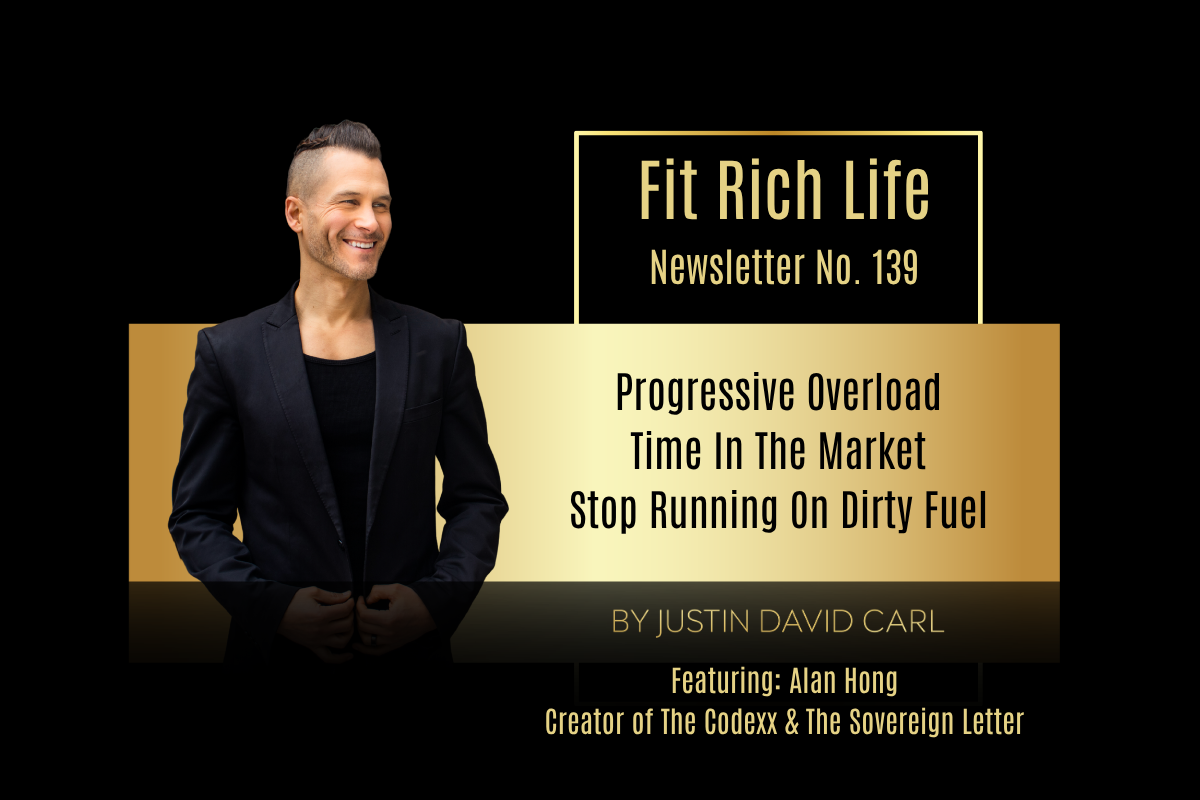
Progressive Overload, Time In The Market, Stop Running On Dirty Fuel | FRLN 139
Most people do not need a better strategy.
They need to understand the state that is running it.
You can train because you love your body — or because you hate it.
You can pursue financial independence because you want freedom — or because you are terrified of ever being poor again.
You can build a wildly successful career from curiosity and contribution — or from a nervous system trying to prove you are finally enough.
Same actions.
Different fuel.
Different internal cost.
This past week's podcast guest, Alan Hong, has become my favorite Instagram follow of 2026 because he gives language to something I have spent most of my life feeling but could not always explain.
Alan is the creator of The Codexx and writer of The Sovereign Letter, where he explores identity, nervous system regulation, coherence, and personal sovereignty.
At the center of our two-hour conversation in Fit Rich Life Podcast Episode 114 was one deceptively simple principle: state before strategy.
Before you ask, "What should I do?" ask, "What part of me is doing it?"
Is it fear? Shame? Scarcity? Revenge? The need to prove something? Or is it love, curiosity, service, play, and the desire to grow? Because the right strategy, executed from the wrong state, can still build the wrong life.
Let's dive in.
FIT — Progressive Overload Without Self-Punishment
When I asked Alan for his best fitness strategy, he chose two connected ideas: hypertrophy and progressive overload.
Progressive overload means giving your body a slightly greater reason to adapt over time. Add a little weight. Do one more rep. Improve your range of motion. Use better control. Add a set when it is earned. Make the movement a little more skillful or demanding.
The keyword is progressive.
The load has to be greater than what your body has already adapted to — but not so far beyond your capacity that it overwhelms your recovery. Training is the signal. Recovery is where the adaptation happens. More stress is not automatically more growth. The right dose of stress, repeated and recovered from, is what builds the body.
I love this principle because it exposes the difference between clean fuel and dirty fuel.
My first six-pack was built with a lot of dirty fuel. At 31, I hired my first fitness coach, tracked every calorie and macro, lost 30 pounds, and went from roughly 18% body fat to 8% in six months. The strategy worked. I am grateful I did it. It permanently changed what I believed was possible for my body.
But pain was doing a lot of the driving.
I wanted to stop being the insecure, kinda-fit, kinda-fat version of myself. I wanted the body to prove something about my discipline, desirability, and worth. The visible result was healthy. The fuel underneath it was not always healthy.
Dirty fuel can produce clean-looking results.
That is what makes it so seductive. Shame can get you to the gym. Fear can make you track every bite. Self-rejection can create an impressive transformation photo. Pain is powerful fuel — especially at the beginning.
But if pain remains the only fuel source, you never arrive. The mirror improves while the voice looking into it keeps finding another flaw. The workout stops being an act of expansion and becomes punishment for not being enough yet.
I still train hard. I still track every set and rep. I still want to get stronger, remain lean, build muscle, improve my pickleball game, and test the outer edge of what my 44-year-old body can do. Clean fuel does not mean soft goals or weak effort.
It means I am challenging my body because I love it — not attacking it because I hate it.
Today, fitness gives me energy to create, play pickleball, hike and trail run with Carly, travel, think clearly, and live fully. The discipline may look similar from the outside. The internal experience is completely different.
Progressive overload is not only a training principle. It is a relationship with yourself: enough challenge to grow, enough safety to adapt, and enough patience to let the body become stronger without treating it like an enemy.
RICH — Time In The Market Requires A State That Can Stay
Alan said that when he worked as a financial planner, his best investing advice was simple: time in the market, not timing the market.
The strategy is almost painfully boring. Buy low-cost, broadly diversified investments. Keep contributing. Leave the money alone for decades. Let businesses grow, dividends reinvest, and compounding do work that becomes more visible with time.
The math is not the hardest part.
Staying is the hardest part.
A frightened state sees a market decline and sells to make the fear stop. A scarcity state hoards cash forever because no amount feels safe. A FOMO state watches somebody get rich quickly and abandons the plan to chase the hot stock, crypto coin, IPO, or trade. A bored state demands that the portfolio entertain it.
The investing strategy can be perfectly rational while the human being operating it is completely activated. That is why state comes before strategy in money too.
When I discovered financial independence, I did more than change my budget. I chose a new identity. I went from looking-rich Hollywood Justin — driving the Range Rover, living in the high-rise condo, spending 110% to 120% of what I made — to Financial Independence Journey Justin.
I sold the Range Rover and bought a 2012 Prius. I stopped eating at restaurants for almost three years unless somebody else was paying. I grew my income, created a massive gap between what I earned and spent, and invested the difference into low-cost index funds. I religiously consumed FI books, blogs, podcasts, and the stories of people who had already walked the path.
The strategy taught me what to do.
The identity made the strategy feel natural.
I did not go from $80,000 in debt, six years behind on taxes, and ruined credit to a multimillionaire because I found the perfect moment to invest. I did it by increasing the inputs I could control — income, savings rate, and contributions — and refusing to interrupt compounding every time the world became scary.
Time in the market is not passive. It requires the emotional capacity to remain invested through recessions, wars, elections, bear markets, terrifying headlines, and the maddening years when somebody else's concentrated bet appears to be beating your boring plan.
The solution is to write your rules from a calm state so you do not have to invent them from a threatened one: automate the contribution, choose an allocation you can actually hold, decide how much — if any — is allowed for speculative fun, and stop requiring your portfolio to make you feel excited.
A good money system protects your future from the temporary state you are in today.
You do not need to predict the market. You need a plan your nervous system can survive long enough for the market to reward your patience.
LIFE — Stop Running On Dirty Fuel
Alan's story explains why this matters far beyond fitness and money.
His parents came to Australia as refugees after growing up around war, poverty, and daily survival. Australia was safer, but their nervous systems did not instantly receive the memo. The programming that had helped them survive followed them into the new country and shaped how they raised Alan: work hard, keep your head down, do not stand out, do not fight back, and do not risk making things worse.
Alan was bullied and learned to minimize himself. At his high-school graduation, he walked across the stage and nobody clapped. That moment hardened something in him. At 19, he swung from victim to what he calls villain.
He entered alpha-male circles, learned sales, built his body, chased money and status, and refused to take shit from anyone. From the outside, it looked like confidence. Inside, he was angry, exhausted, and still organizing his life around the same old wound.
He had changed the performance without changing the state.
That is one of the most important ideas in this entire episode. If you feel powerless, becoming powerful can be healing. But if the power is still organized around terror of ever feeling weak again, the old identity remains in charge. It is wearing a better suit, lifting more weight, and earning more money — but it is still running the system.
Alan eventually found a community that showed him unconditional love and helped him see a third path. Not victim. Not villain. Sovereign. The Codexx began as a public diary where he could metabolize that transformation and share the tools he wished someone had given him earlier.
One of those tools came from nonviolent communication. Under almost every behavior is a need. The need creates a feeling, and the feeling drives a strategy. The need itself is not wrong. The strategy is the part we can change.
You may need safety. Significance. Love. Freedom. Belonging. Rest. Expression. Challenge. The problem begins when you meet one legitimate need with a strategy that repeatedly violates the rest of you.
You can meet the need for significance by collecting status, titles, money, followers, and people who envy you. Or you can meet it through contribution, mastery, deep relationships, and work that matters to you. You can meet the need for safety by trying to control everything and accumulating money you never allow yourself to enjoy. Or you can build boundaries, reserves, skills, and a simple plan that lets your body finally exhale.
The need is valid. The strategy is negotiable.
I could see my own life inside Alan's framework. At Stanford, I followed the script toward investment banking because that was what successful students were supposed to do. I knew almost immediately that it was not right for me. Then I escaped into Hollywood nightlife, where I found music, art, fashion, culture, money, beautiful people, and enormous external validation.
Within a year and a half, I knew that was not my long-term path either. I stayed for another six and a half years because the strategy was meeting powerful needs: money, identity, significance, belonging, and the feeling that I was the man.
The rewards were real.
So was the self-abandonment.
I used alcohol and drugs to suppress the growing distance between the life that looked successful and the life that felt true. Eventually the cost exceeded the value. The pain became louder than the applause. I had to leave, get sober, and build a completely different relationship with work, money, my body, and myself.
Alan calls the opposite of survival coherence: your mind, body, heart, and actions moving in the same direction.
Coherence does not mean you never feel afraid, conflicted, ambitious, or activated. It means you stop automatically handing those states the keys. You can hear the fear without letting it choose the destination. You can feel the old scarcity without forcing your whole life to keep proving it wrong.
And sovereignty is the governance system that protects that coherence. Alan explained it through statecraft: a sovereign country manages its own affairs and does not outsource its decisions to another state. Personal sovereignty is the same. You can seek advice, learn from experts, and borrow other people's wisdom without surrendering agency over your life.
The goal is not to become unteachable.
The goal is to remain self-governing.
Dirty fuel is not evil. Fear, pain, anger, shame, and the need to prove yourself may have saved you. They may have gotten you out of debt, into the gym, away from an unhealthy relationship, or through a season you genuinely needed to survive.
Thank that fuel for getting you here. Then ask whether it deserves to run the next chapter.
Maybe the ambition stays, but the source changes. Maybe you still build wealth, but not because you are trying to outrun poverty forever. Maybe you still train hard, but not because your body has to earn love. Maybe you still create, lead, sell, achieve, and win — but from curiosity, devotion, service, play, and the joy of discovering what you are capable of.
You do not have to shrink your goals to stop abandoning yourself. You have to change the fuel.
ACTION — Change The Fuel, Not Just The Goal
Pick one thing that's gonna move your life forward. Don't do all of them. Do one.
FIT — Choose one lift or movement and write down your current honest capacity. In the next session, add the smallest meaningful challenge: one rep, a little more weight, better range, or cleaner control. Then choose one recovery promise that lets your body adapt. Challenge it. Do not punish it. Then track this exercise (every set & rep) for 4-12 weeks to ensure you're locking in progressive overload.
RICH — Write a one-sentence investment rule:
"I automatically invest $______ (or ___%) every ______ into ______, and I will not change the plan because of a headline."
Make the transfer automatic. Let a calm decision govern the emotional days.
LIFE — Choose one goal you keep forcing or avoiding. Finish these sentences:
The need underneath this goal is _________.
The state I usually pursue it from is _________.
My current strategy costs me _________.
A cleaner strategy that still meets the need is _________.
Then take one action from the cleaner state within 24 hours.
You do not need to erase every survival program before you move forward.
It kept you alive.
It got you here.
It just does not have to govern where you go next.
Muscle grows by adapting to the right load. Wealth grows by remaining invested through time. A life grows when your actions stop fighting your deepest truth.
Progressive overload — not punishment.
Time in the market — not emotional timing.
Coherence — not self-abandonment.
Do not just build a life that looks powerful from the outside. Build one your mind, body, and heart can safely live inside.
To your health, wealth, and happiness,
— Justin David Carl
P.S. — Listen To Fit Rich Life Podcast Episode 114
My conversation with Alan Hong is one of the most personal and intellectually expansive episodes I have recorded. We go deep on his journey from victim to villain to sovereign, the hidden cost of pain-driven success, state-first identity shifts, self-abandonment, coherence, and building a powerful life without destroying yourself in the process. Listen on Spotify, Apple Podcasts, YouTube, or on the web. Then ask yourself: What fuel is running my life right now?