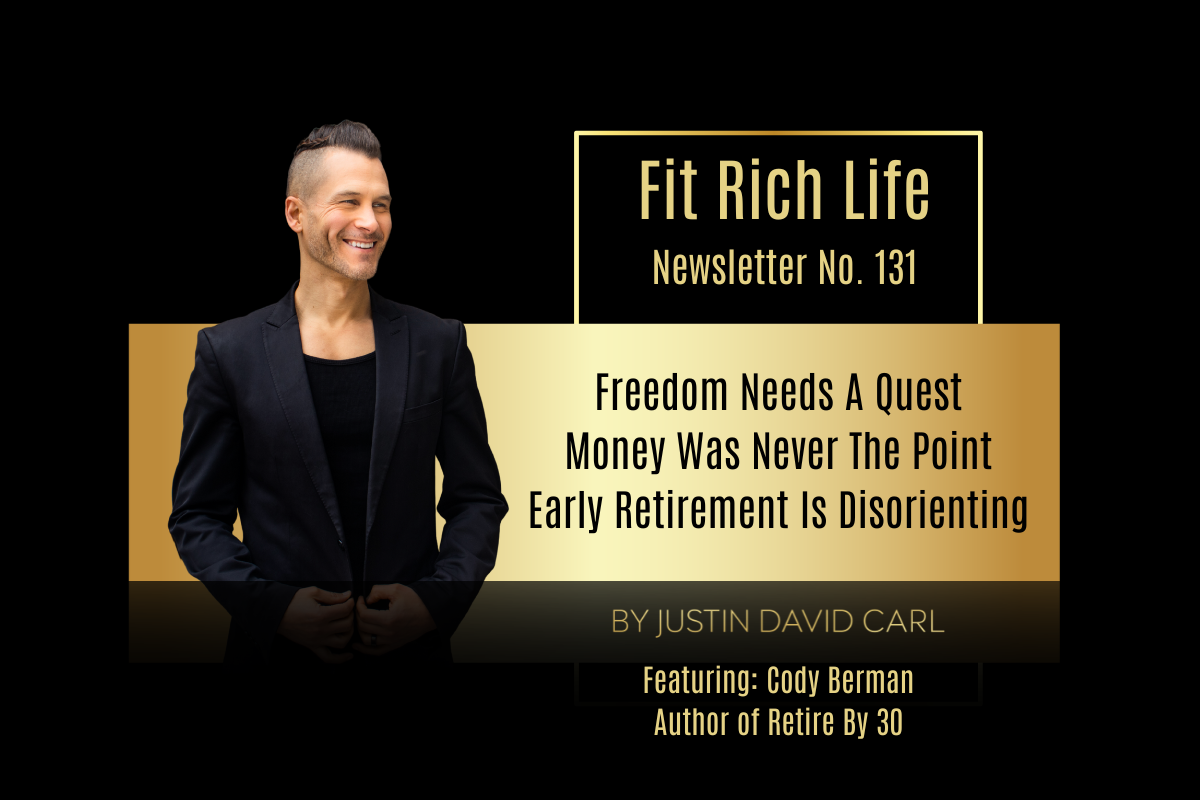
Freedom Needs A Quest, Money Was Never The Point, Early Retirement Is Disorienting | FRLN 131
Happy belated 4th of July.
Since we just celebrated Independence Day, I’ve been thinking a lot about freedom.
Not abstract freedom.
Not red-white-and-blue freedom.
Not “one day I’ll be free” freedom.
Real freedom.
The kind you can feel in your body.
The kind you build with your money.
The kind you protect with your time, energy, relationships, health, and purpose.
And that’s why this past week’s Fit Rich Life Podcast episode (110) is so perfectly timed.
Cody Berman is back on the show.
Cody is the author of Retire By 30, a financially independent entrepreneur, investor, creator, and one of the most impressive young people I know.
In our previous conversation, we did the classic deep dive into fitness, money, and life tips, tools, and strategies.
This episode was different.
This was less of an interview and more of a real conversation between two people who reached financial independence in very different ways.
Cody reached FI in his twenties through entrepreneurship.
I reached FI after 10 years in Bay Area tech sales.
Cody is 30.
I’m 44.
Cody has been out of the corporate work world much longer than me.
I’m just over two years removed from my 9–5 job.
And this conversation became one of my favorite ones we’ve ever recorded because we didn’t just talk about how to reach freedom.
We talked about what happens after you get there.
Because here’s the thing most people don’t realize:
Freedom is not the finish line.
Freedom is the beginning of a much deeper question.
What are you going to do with your freedom?
Let’s dive in.
FIT — Freedom Needs A Quest
One of the biggest lessons from this conversation:
The human spirit needs a quest.
Especially if you’re a high achiever.
Especially if you’re pursuing financial independence.
Especially if you’re someone who spent years climbing the mountain of career, business, savings rate, investing, net worth, and optionality.
Most people think freedom means doing nothing.
And yes, sometimes freedom does mean rest.
Sometimes freedom means sleeping 10 to 12 hours a night because your body is finally decompressing from years of pressure.
That was my experience.
When I left the tech world, I didn’t realize how exhausted my nervous system was.
For 10 years, I was in the Silicon Valley startup vortex.
Growth.
Revenue.
Pressure.
Targets.
Expansion.
More.
More.
More.
I loved parts of it.
I thrived in parts of it.
I also didn’t fully realize how much pressure I had been under until I left.
For the first year after exiting, I slept 10 to 12 hours almost every night.
My body was basically saying:
“Bro, we pushed hard for a decade. Now we recover.”
That decompression was necessary.
But eventually, rest alone was not enough.
Because freedom without a quest can turn into aimlessness.
And aimlessness can become sadness, restlessness, or depression.
That’s when pickleball entered my life.
I started playing on April 12, 2025.
At first, it was just something fun to try with a friend.
Then I became obsessed.
Now my life revolves around a plastic wiffle ball.
And I love it.
I play, drill, train, and compete every week. I’ve made 100+ new friends. I see the same people multiple times a week. I laugh constantly. I get to challenge myself physically, mentally, emotionally, and socially.
And I’m not doing it for money.
I’m doing it because it lights me up.
That’s freedom.
Not just having time.
But having the space to discover what brings you alive.
Cody is wired similarly.
He loves challenges.
Hyrox.
Marathons.
The gym.
Building businesses.
Creating.
Pushing toward a North Star.
We talked about this idea that every person needs a quest.
Your quest could be:
Getting strong.
Training for a race.
Learning pickleball.
Building a business.
Healing your relationship with food.
Improving your marriage.
Learning Spanish.
Writing a book.
Building a deeper community.
Becoming a better parent, partner, friend, creator, or coach.
The quest itself can change.
During COVID, I was obsessed with gymnastics rings training.
Now I’m obsessed with pickleball.
That’s okay.
Your values evolve.
Your interests evolve.
Your season of life evolves.
The point is not to pick one quest forever.
The point is to keep asking:
What is the next meaningful mountain I want to climb?
And here’s the key:
Don’t wait until you reach financial independence to start living your values.
If you think you’re magically going to become fit, creative, adventurous, connected, and purpose-driven once your net worth hits a certain number, you’re lying to yourself.
FI gives you more time.
But it does not automatically give you identity, health, purpose, or joy.
You have to start building those now.
When I was still working in tech, I used to live my dream life from 5–9 before my 9–5.
I worked out.
I coached.
I podcasted.
I wrote.
I gave my best energy to my actual life.
Then I gave my job my “sloppy seconds.”
And I still was the top performer for a decade.
You don’t need to wait for freedom to begin living freely.
Start with the freedom you already have.
RICH — Money Was Never The Point
Let me tell you the most important thing Cody said in the entire episode.
"We're doing it for freedom. That's the whole point. And sometimes people miss it."
Read that again.
Because so many of us in the FI community get it exactly backwards.
We treat the number as the destination.
We treat the net worth as the scoreboard.
We treat the spreadsheet as the finish line.
And then we hit the number… and keep hammering the income button anyway.
Cody did this. He hit FI at 25 and admitted it took him until 28 or 29 to actually internalize what that money had bought him. He kept grinding. Kept optimizing. Kept treating scarcity like a fact when the spreadsheet was screaming abundance.
I did the exact same thing.
My original FI number was $1.5 million.
By the time my company got acquired and let me go, I was at $2.7 million.
Almost double what I needed.
And what did I do?
I immediately decided to go make half a million dollars a year with my online business.
Why?
Because I was on default mode.
I went from high-achieving salesperson to high-achieving solo entrepreneur without ever stopping to ask if I even needed the money.
I didn't.
Neither did Cody.
Neither, probably, do a lot of you.
So let's talk about what freedom actually looks like on the money side.
Freedom is working in seasons.
Cody goes hard — 60 to 80 hour weeks — for a month or two at a time. Then he takes a month off and works an hour a day. He travels three to four months out of the year. He gets to do this because he built something most people never build.
Systems.
Cody's main business makes $80,000 to $90,000 a month take-home. He's 30. He can disappear on a four-month trip and check Slack for a few minutes a day, and the money keeps coming.
How?
He built the machine before he needed it.
He wrote down every process.
He recorded every SOP.
He built a 1,200-day email sequence — four years of emails that go out whether he's typing or on a beach in another country.
He plugged the leaky bucket that catches most creators, the ones with huge followings and no funnel who make nothing because everything spills out the sides.
This is the part people skip.
They think passive income is magic.
It's not.
It's work you do once and get paid for forever.
And here's where I'll be honest with you, because this is exactly the shift I teach inside Investing Mastery.
Building the money machine is only half of freedom.
The other half is knowing what the money is for.
Cody said something I can't stop thinking about. He uses ChatGPT as a kind of money coach, and it keeps telling him the same thing:
Dude, you have to spend more money.
He's so far past his FI number that he'll die with more than he could ever use.
And he still catches himself under-spending in the categories he actually values.
Travel. Experiences. Time with Lauren.
So here is the reframe that changed everything for me.
Stop maximizing net worth.
Start maximizing net life.
Once you hit your number, growing the pile is no longer the priority.
The quality of your life is the priority.
You can still grow your net worth, but that should come as a distant second to maximizing the quality & experience of your life.
That's what the money was always for.
That's what freedom actually means.
LIFE — Early Retirement Is Disorienting
Here is the part of my early retirement I don't talk about enough.
The first year sucked.
I'll say it plainly.
The first nine or ten months, I was not happy.
I felt lost.
I felt insecure.
I felt like I didn't know who I was anymore.
For ten years, I was the top sales performer at my company. I walked into OpenAI when there were 30 people. Uber. Lyft. Reddit. My ego loved it. My identity was welded to being that guy.
And then I wasn't that guy.
And the question came.
Who am I?
If you've ever hit a big milestone and felt strangely empty on the other side, you already know this feeling.
So let me give you the three things that saved me. Because Cody and I unpacked all of them.
1. You need to decompress. And you need to let yourself.
When I finally left the innovation vortex of Silicon Valley — a mile and a half from Sand Hill Road, a few miles from Meta & Google — I discovered something.
For ten years, I'd been sleeping five and a half to six and a half hours a night.
Not because I lacked time.
Because I couldn't shut the pressure off.
I was swimming in water so pressurized I didn't even know it was water.
Then we moved to Santa Cruz, which is on the outskirts of Silicon Valley, and I was laid off from my 9-5 job (due to our company being acquired).
After I was laid off, I slept.
10 to 12 hours a night.
Every single night.
For twelve months straight.
That wasn't laziness.
That was ten years of debt coming due.
That was my body saying, we pushed hard, now we rest.
Give yourself the decompression.
Two months. Four months. Six months. A year.
Who cares.
You've got the rest of your life to pick up projects.
2. You are going to go through a transition. That's not a bug. That's the process.
I read a book called Transitions by William Bridges that reframed everything.
There is an in-between time.
A neutral zone.
The space after the old thing ends and before the new thing begins.
And it is deeply, profoundly uncomfortable.
But it is necessary.
The moment I understood the discomfort was part of the process — not a sign I was failing — I relaxed.
I stopped forcing an answer.
I started exploring with no expectation.
And then one random day I texted a friend: want to try pickleball?
I found the next quest.
But only because I let myself be in the unknown long enough to stumble into it.
You retire from a job — massive transition.
You go through a divorce — massive transition.
You lose someone you love — massive transition.
Learn to sit in the unknown.
You will come out the other side. You always do.
3. Community is an asset class. Build it like your life depends on it. Because it does.
This is the one I got wrong.
When I left Menlo Park, I left an 80-person FI meetup group I'd built. I left my Stanford friends. I left my rollerblading crew. I left my whole community.
And for two and a half years in Santa Cruz, I did a terrible job replacing it.
I wasn't happy.
Then I started playing pickleball, joined a new gym, and suddenly had a hundred new friends.
And I was happy again.
It's almost embarrassing how simple it is.
The World Health Organization found that isolated people face a 50% greater risk of premature death.
Fifty percent.
Money can't buy you out of that.
You can have millions in the bank and a net worth of zero in the only asset class that actually keeps you alive.
So build the community asset.
And build it wide.
Cody said the smartest thing about this. There's a loud crowd online screaming ditch your old friends, only hang out with people richer than you.
He calls that the dumbest thing ever.
Keep the grade-school friends.
Keep the hometown crew.
Keep the people who don't invest, don't care about FI, and love you anyway.
Because Cody doesn't have one community.
He has pockets of them.
Old friends.
FI friends.
Entrepreneur friends.
Fitness friends.
Family.
People who care nothing about money.
People who are way ahead of him financially.
People he can learn from.
People he can support.
And that matters.
You do not need every friend to share every value.
Some friends are pickleball friends.
Some are money friends.
Some are childhood friends.
Some are business friends.
Some are deep emotional support friends.
Some are adventure friends.
Together, they form the community asset class.
And this asset class pays dividends.
Dividends in happiness.
Dividends in health.
Dividends in opportunity.
Dividends in support.
Dividends in meaning.
And get in rooms where you're the dumbest person — because those rooms break your frame and show you what's possible.
You don't have to choose.
Be the lighthouse for some.
Go looking for a lighthouse in others.
You can be both.
And whatever you do, be the lighthouse, not the tugboat.
The tugboat tries to drag people toward the life you think they should live.
It never works. They just get annoyed and you get frustrated.
The lighthouse just stands there.
Living its best life.
Shining.
And letting people find their own way toward the light.
That is freedom.
Not just being free yourself.
But living so freely that you give other people permission to be free too.
ACTION — Keep Leveling Up
Pick one task per area. Don't do all of them. Do one.
FIT — Pick a quest with no financial upside. A race. A skill. A physical challenge with a three-year horizon. Something you'd chase purely for the joy of getting better. Then put the first session on your calendar this week.
RICH — Open your calendar and your credit card statement side by side. Ask the one question Cody asks every month: is how I'm spending my time and money actually in alignment with what I say I value? Circle one thing to cut and one thing to spend more on.
LIFE — Audit your community asset class honestly. Name your pockets of people — old friends, FI friends, activity friends, frame-breakers. Where's the gap? Take one action this week to fill it: text an old friend, sign up for a meetup, or walk into the room where you'd be the dumbest person there.
Freedom isn't the fireworks.
Freedom isn't the number.
Freedom isn't even the day you walk away from the job.
Freedom is what you build along the journey.
The quests. The systems. The community. The life.
That's the whole point.
Don't miss it.
To your health, wealth, and happiness,
— Justin David Carl
P.S. Fit Rich Life Podcast Episode 110 (Spotify, Apple, YouTube, Web) was another banger sit-down with Cody Berman. His new book, Retire By 30, is out now and hit #1 bestseller in 16 hours for a reason. Go grab it. And go listen to FRLP 110 — we went deep.