Fitness You Can Show Up For, Net Worth & The Need For More, Keep The Fire (Release The Fear) | FRLN 144
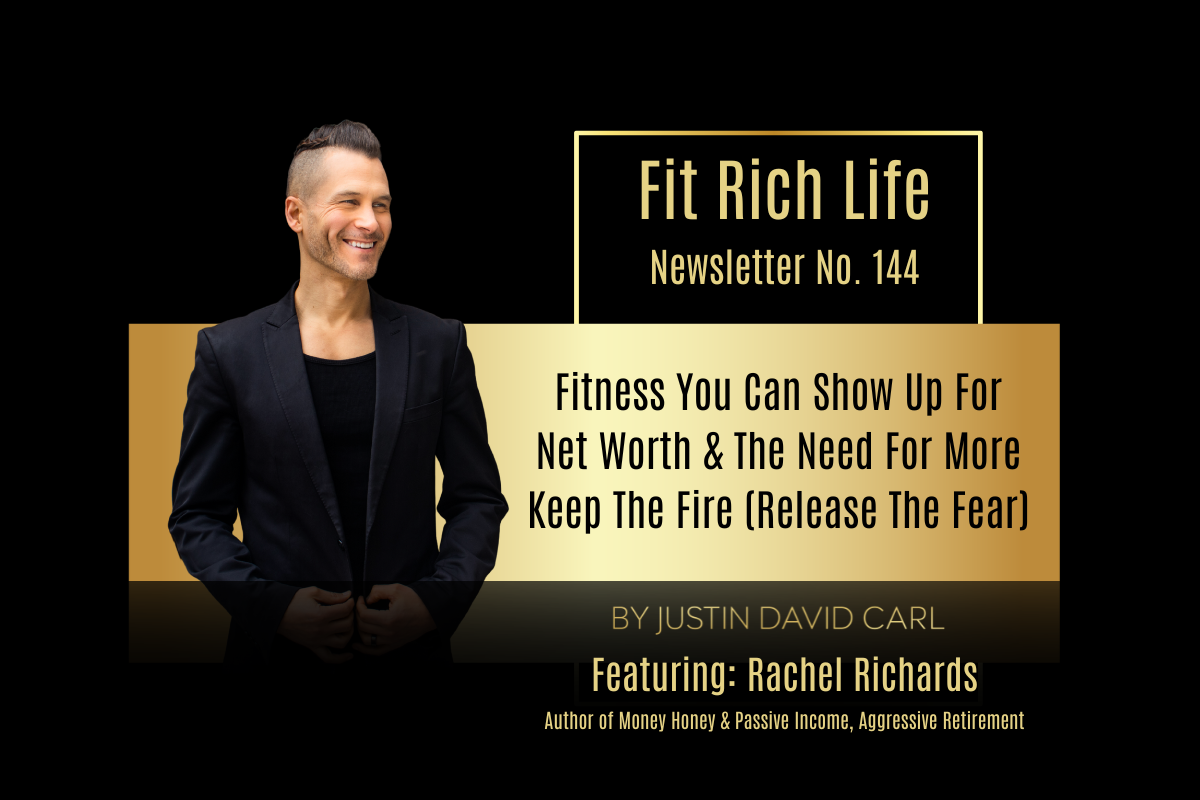
I invited Rachel Richards onto the podcast to talk about financial freedom.
We ended up talking about whether I believe I deserve to be loved without earning it.
This one went deep.
Rachel and I met at Econome earlier this year through our mutual friends James and Emily Lowery.
Rachel is the author of Money Honey and Passive Income, Aggressive Retirement. She reached financial independence and left her corporate job at 27. Later, she built a successful online business around helping other people with money.
Then she walked away from that, too.
She told me the business was on track to generate roughly $600,000–$700,000 in profit the year she shut it down. But she had already reached financial independence, and she no longer wanted the day-to-day life that came with running it.
Making that decision brought up a much harder question:
If you stop doing the things that make you feel impressive, can you still feel good about who you are?
That question hit close to home for me.
In Fit Rich Life Podcast Episode 116, we talked about strength training, accountability, tracking money, and creating a life you actually enjoy. We also got into the connection between achievement, identity, and the feeling that you have to keep proving yourself.
There are practical tools here you can use this week. And since the interview, I’ve continued exploring what came up through journaling with self-tarot readings and EFT tapping.
One idea keeps bringing me back to the same question:
Can I keep my ambition without asking achievement to prove that I deserve love?
Let’s dive in.
FIT — Build A System You Can Show Up For
Rachel knew the basics of getting in shape. Her challenge was staying consistent.
She would get into a routine, travel for a couple of months, and lose momentum. Trying to do it entirely on her own wasn’t working the way she wanted it to.
So she created the accountability she needed.
Together with our friend James Lowery, she started a six-month fitness challenge called Better Body. The structure centers on 10k daily steps, workouts with an emphasis on lifting, and meeting an individual protein goal. There’s a community doing it together, and missing a weekly requirement comes with a $100 fine.
Rachel was determined not to pay a fine in her own challenge, so she made sure she met every requirement each week. That accountability kept her showing up, even when she might otherwise have let a habit slide.
But the part that stood out to me was what happened when she kept coming back, round after round. She described getting stronger, changing her body composition, enjoying hiking, and no longer worrying about whether she could lift her luggage into an overhead bin.
Her progress came from finding a structure that helped her stay consistent long enough for the basics to work.
You can create your own accountability. Schedule workouts with a friend, join a group, or work with a coach. And if Rachel’s approach feels aligned with what you need, check out the Better Body challenge. The point is to choose a commitment that matters to you and fits your actual life.
Rachel’s two practical tracking tips were straightforward: track your lifts and track your protein.
She had been recording workouts in her phone’s notes and wanted to get more systematic about reviewing previous weights and reps. That gives her something concrete to build on. In the interview, I shared that I use the Strong app for my own workout tracking.
Her experience with protein was revealing, too. She assumed she ate enough until she tracked it and discovered she was getting only about 40–50 grams a day. Checking what she was actually eating gave her information she could act on.
We also talked about how easy it is to get attached to a particular number on the scale. When someone tells me they want to lose 20 pounds, I like to ask: if you only lost three pounds but felt strong and loved the body you saw in the mirror, would that bodyweight number still matter so much?
Usually, the answer is no.
That brought us into something more personal. For years, I tried to beat my body into shape. In my early thirties, while working with a fitness coach, I also started a practice Carly suggested: standing in front of the mirror and saying that I loved, approved of, and accepted my body.
I did it naked (crazy, I know). Some days I felt ridiculous. Other days I cried. Ultimately, it was incredibly healing for my relationship to my body.
You can want to get stronger and improve your body without treating your current body as something to be ashamed of.
Track what helps you. Build support around the habits you want. And pay attention to the way you speak to yourself along the way. That shift from trying to beat myself into shape to learning to love myself into shape is something I’m now exploring beyond fitness, too.
RICH — Net Worth & The Need For More
Rachel’s money tip was simple: if she’s going to track one financial measure each month, it’s her net worth.
Early in her journey, she tracked everything, right down to individual transactions. That helped her understand her spending and build the savings that funded her first real estate investments.
As her finances became more established, she simplified. She still uses her own Excel spreadsheets, but the monthly net worth check gives her a useful view of the bigger picture.
I’ve always used an app to track my money and net worth — I’ve never used a spreadsheet for it. Choose a tool you’ll actually keep using. What matters is having a clear picture of where you stand and checking in consistently.
What do you own? What do you owe? How is the difference changing over time?
If it’s falling, investigate why. A market decline and spending beyond your plan call for different responses. A single month gives you information; the longer trend gives you context.
Use your net worth to understand your financial position. Be careful about using it to decide how you feel about yourself.
That second part is where our conversation got interesting.
Rachel built wealth through frugality, growing her income, and investing. Those habits helped her reach financial independence. But once she had that freedom, she still had to decide how she wanted to spend her time.
That became especially clear with her online business. She originally wanted to write books. Over time, she found herself spending her days creating social media content and feeling pressure to stay available to an audience.
The business was financially successful. She was increasingly unhappy running it.
She already had enough to leave. Accepting that she could leave was its own process.
I recognized myself in that tension. During the interview, I admitted that part of me was scared I might never again earn what I made in tech sales.
Rachel asked:
“Why do you need to make it again though?”
My answer was: “Exactly. I don’t know.”
That exchange says a lot.
I’ve worked hard to shift my priority from maximizing my net worth to maximizing my net life. I love spending time with Carly, playing pickleball, training, being in nature, and seeing friends. Yet part of me still feels the pull of the income and job prestige I used to have.
Rachel asked what that former life gave me that I wasn’t getting now. My answer was more money and more prestige.
Those are useful things to admit out loud. They give me something more honest to examine than the automatic assumption that earning more must be the next goal.
Wherever you are financially, there are two questions worth keeping separate:
What does my financial plan need?
What am I hoping more money will make me feel?
Sometimes you need to earn more, save more, or give your investments more time. Sometimes you also need to examine the feeling that no amount will ever be enough.
Your financial tracking can help with the first question. The second requires a different kind of attention.
LIFE — Keep The Fire. Release The Fear.
After Rachel shut down her business, she lost the familiar feedback that had helped her feel valuable: growing revenue, new followers, engagement, and messages from people she had helped.
She shared something her therapist had told her: she was confident in what she could do, but less confident in who she was.
I felt that.
I know how to work hard and produce a result. Feeling secure in myself when I’m not producing something impressive has been a different kind of work.
At one point, Rachel suggested that it sounded like I was performing for someone whose opinion mattered to me. My mind immediately went to my dad.
I know my dad loves and approves of me no matter what I do. We’ve had a great relationship since high school, and I want to be clear about that.
But after my parents separated, my dad disappeared from my life for a couple of years. A scared child created rules to try to make sense of that: if I got the best grades, excelled at sports, and became impressive enough, maybe I could make sure I was loved and that people would stay.
I still find myself operating from those rules, even though my relationship with my dad has been different for decades. Knowing I’m loved now doesn’t automatically switch off the strategies I developed when I was afraid I wasn’t.
Rachel shared practical ways she worked on this herself. For roughly six months, she wrote a daily list focused on gratitude or things she loved about herself, including her character. She journals in whatever format is convenient and looks back to see how she’s grown. She also writes letters to her future self.
And she stepped away from social media, starting with 24 hours and gradually extending the break. She discovered she didn’t miss it the way she expected to. That gave her room to experience life without constantly checking the response to it.
Since our conversation, I’ve been exploring my own relationship with achievement more deeply through journaling with self-tarot readings. This is something I’ve done for many years but rarely talk about publicly because, well, it’s pretty woo.
Over the past couple of days, I’ve also been using EFT tapping — tapping on meridian points while speaking through feelings and beliefs. I use it with the intention of releasing trauma and old limiting beliefs, installing new empowering beliefs, and making space for healing, integrating what I’m learning, and transforming how I relate to myself.
The readings gave me a set of symbols to reflect on. Three cards in the second reading were Unity, Conjunction, and The Animal. The Animal had also appeared at the end of the previous day’s reading.
The part of the Unity card’s guidebook that stood out to me was about questioning rules we’ve learned from family or society that no longer serve us. For me, that connected to a rule I formed as a kid: I have to achieve something impressive to deserve love and approval.
As a young child, I didn’t consciously choose that rule. But I can see how I’ve carried it into my career, my finances, and even my fitness as an adult. Unity became a prompt to ask: Is this something I actually believe today, or an old rule I’m still following out of habit?
The card also encouraged learning from people who can help us grow. That connected directly to my conversation with Rachel. Hearing her describe her own experience helped me recognize a pattern in myself that I wanted to change.
Conjunction gave me a way to think about what that change could look like: bringing my ambition and my sense of being enough together. The Animal brought my attention back to experiencing life in my body.
That idea of bringing two parts together is especially useful to me.
Because I love the achiever in me. I love big goals, competition, learning, building, and seeing what I’m capable of. That drive has helped me create a life I love.
I also recognize that some of it has been connected to the belief that I need to be exceptional to feel safe or worthy of love.
I can keep the ambition while learning to let go of the demand that it prove my worth.
A phrase from these reflections captures what I’m working toward:
Keep the fire. Release the fear underneath the fire.
Two motivations can lead me into the same workout, project, or opportunity. One is curiosity: I wonder what I’m capable of? The other is pressure: I need to prove I’m enough.
I’m learning to notice both without judging myself for having either. The part of me that learned to achieve deserves understanding, too. I don’t need to turn another part of myself into a problem to conquer.
The tapping sequence put words to that possibility:
I can want more while knowing I am enough.
I can pursue excellence without pursuing worth.
I can make money without asking money to make me valuable.
Those are ideas I’m practicing, rather than a transformation I’m declaring complete.
The repeated Animal card also gave me a question to sit with: how much time do I spend explaining my life to myself, and how much time do I spend simply experiencing it?
I can analyze this pattern all day. Giving myself room to rest, play, or enjoy being outside without turning it into another measure of progress is a different practice. Even personal growth can become another thing I feel pressure to excel at.
I want to make room for both doing and being — for pursuing something I love and feeling okay when I’m not accomplishing anything.
That connects back to one of my favorite things Rachel said:
“You don’t have to make a big impact to make a positive impact.”
Being present with someone matters. Kindness matters. The moments that never become a post or an achievement still matter.
And I’m taking that reflection one step further: on the days when I have little energy to give, can I still let myself feel worthy?
Here’s the question I’m carrying forward:
If I knew with absolute certainty that I was already safe, already loved, and already worthy, what would I still choose to achieve?
I’m curious to see what I choose from that place.
ACTION — Level Up Your Life
Choose the one that meets you where you are this week:
FIT: Download the Strong app or another workout-tracking app and start logging every strength workout — every set, every rep, and the weight you use. Review your previous session before you start so you know what you’re building on.
RICH: Update your net worth and look at the trend. Then write one sentence answering: “What am I hoping more money will give me at this stage of my life?”
LIFE: Take one goal you’re pursuing and ask: “If I already felt safe, loved, and worthy, would I still want this?” Spend five minutes writing about what you enjoy in the goal itself and what you hope achieving it will prove.
I want to keep growing. I love a meaningful challenge, and I’m proud of what I’ve built.
I also want to enjoy the life I have without feeling like I have to keep auditioning for it.
Keep the fire. Release the fear.
To your health, wealth, and happiness,
— Justin David Carl
P.S. Listen to Fit Rich Life Podcast Episode 116 (Spotify, Apple, YouTube, Web) with Rachel Richards for the full conversation. We went deep into financial freedom, walking away from a successful business, fitness accountability, and the self-worth questions that can follow you long after you’ve achieved your goals.