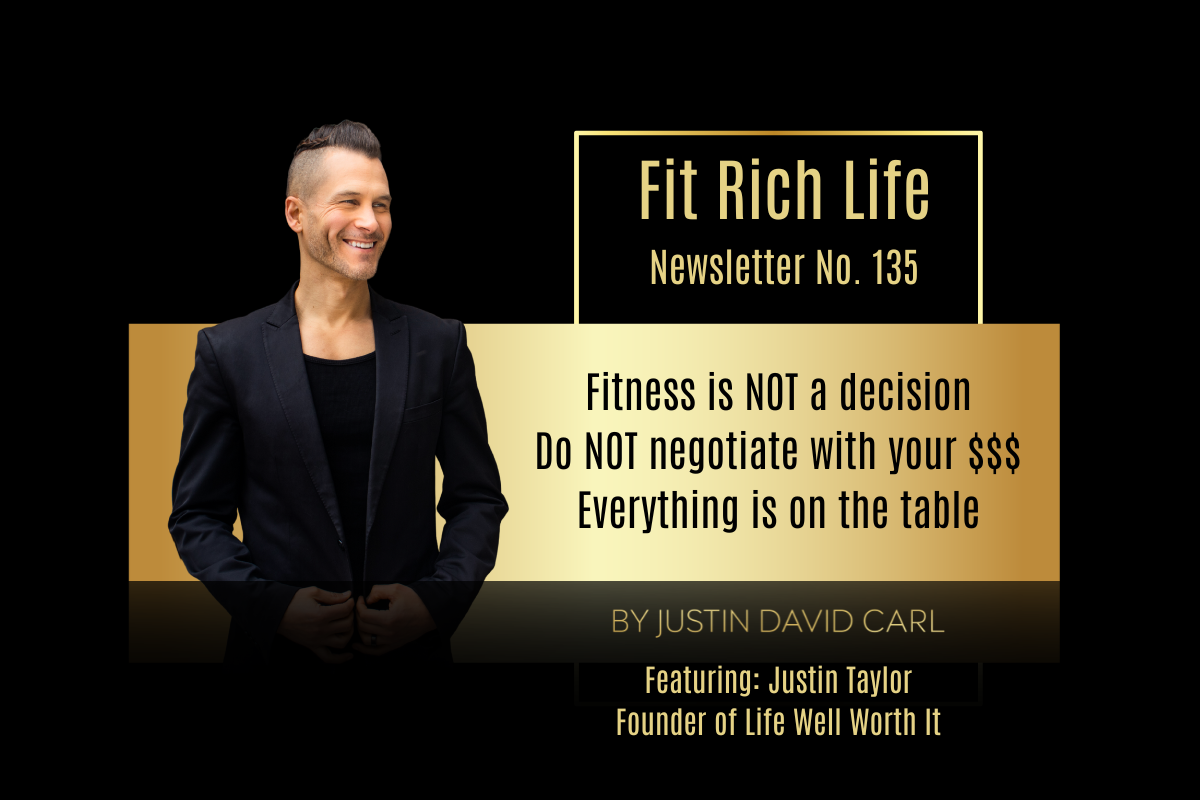
Fitness is NOT a decision, Do NOT negotiate with your money, Everything is on the table | FRLN 135
Most people don't have a fitness problem.
They don't have a money problem.
They have a deciding problem.
They decide again every morning.
Should I train today, or rest.
Should I eat this, or not.
Should I buy, sell, or hold.
Should I keep doing what I'm doing, or do what everyone else is doing.
And every one of those decisions costs something. Not money.
It costs energy. The exact energy you needed to build the life you say you want.
So you drift into the default.
And the default is out of shape, broke, and living a script somebody else wrote for you.
This past week's podcast guest solved that in his early thirties.
Justin Taylor came back on the show for his second appearance — Fit Rich Life Podcast Episode 112 — and at the end I asked him for his tips, tools, and strategies for fitness, money, and life.
Three answers.
One idea underneath all three.
Decide once. Then stop negotiating.
FIT — fitness is NOT a decision
Here's what Justin said when I asked him for his fitness strategy:
Make it your lifestyle. Not a decision you make every day.
That's it. That's the whole thing.
He doesn't schedule a workout around his social life. His workout is his social life. When a buddy wants to hang out, he doesn't hunt for a restaurant or a bar or a movie. He plans a run. He plans a lift.
And the food is the same. He learned to cook meals he actually looks forward to. Not meals he survives.
That distinction matters more than anything else in fitness.
Because here's what he told me: don't do the crash diet that cuts out every food you love. Don't do workouts you hate. Of course you won't stick to that. You hate it.
There are hundreds of training modalities. There are thousands of ways to build a diet. Find the one you love enough to keep.
That is the whole game.
I am living proof of this one.
I firmly believe that if you want to be fit, it has to become your lifestyle. Because if fitness is your default way of living, you are always going to be fit. It stops requiring willpower. It just requires you being you.
When I travel, I'm looking for the fitness experience of the trip just as much as the sightseeing. Visiting a gym in another city is like going to a playground I've never been to. Running through a new neighborhood is an obstacle course I've never raced. If there's no gym and I'm road-tripping, I bring a kettlebell in the car. Or I find a kids' park with monkey bars and do pull-ups, push-ups, air squats, and sprints through the grass.
For three years I didn't eat out at restaurants unless someone else was paying. Every time a friend invited me to a meal, I said the same thing: how about a hike instead? How about a workout? How about a walk?
People loved it.
I loved it.
It kept me fit and it made them fitter.
And it works even better when the lifestyle is anchored in community. Justin has Austin, which has one of the best fitness cultures in the country. I have Santa Cruz — an incredible pickleball community, an incredible bodybuilding community, an incredible surf community. I don't even surf and I can feel it.
There is a fitness community where you live. There is one in every geography on earth. You just have to decide it's part of your life.
Then a fit and healthy body is the byproduct.
Want the proof this actually holds up under pressure? Justin and his wife Leslie spent six months out of the country. Philippines, Indonesia, Vietnam, Thailand, the Netherlands, Switzerland, Italy. No food scale. No home gym. Hotel breakfasts where they'd order four omelets stuffed with burrata and bacon because they could.
He got a DEXA scan before he left and another when he got home.
Body fat went from 10% to 11%.
Lean muscle mass went up a pound.
Six months. Eating like a king. Because the lifestyle traveled with him — they averaged ten miles a day of walking and running, and hit a gym whenever one appeared.
A few months later, having barely touched a barbell, he pulled a 435-pound deadlift.
That's not genetics. Justin grew up the fat kid. His words, not mine.
Now he's the fit guy other people admire.
That's what happens when fitness isn't a decision anymore.
RICH — do NOT negotiate with your money
This is one of the best lines anyone has said on my show this year.
Justin's money strategy: no negotiating.
Build the plan. Build your rules of operation. Your style of investing, your rules for investing. Then treat it as a contract with yourself. A legally binding document.
Set it and forget it.
Automate the drafts. Name the index funds you auto-invest into. Decide, in advance, that you are not getting suckered into the IPO or the individual stock or the coin.
Or — and this is the part I love — decide in advance that you are allowed to play.
Ten percent goes into the fun stuff.
Not eleven.
Not twelve.
Ten.
Then he said this: "It's kind of like, we don't negotiate with terrorists. And in this situation, we are the terrorists."
Read that again.
The person trying to talk you out of your plan at 9:47pm on a Tuesday is not the market. It's not your broker. It's not the news.
It's you.
And you are very persuasive.
I run the same system. Ninety percent of my investments live in three index funds.
Ten percent I get to play with. If there's an individual stock I want or I want to add some Bitcoin — it comes out of the ten. Done. No wishy-washy back and forth. No sleepless nights.
I watched this play out in real time with the SpaceX IPO. So many people agonizing, spiraling, doing the math on money they hadn't set aside for that purpose.
And I kept thinking: if you have to think through whether or not to invest in SpaceX, I already know you're not financially independent. Because that's not how financially independent people think.
That's not a knock. It's a diagnosis.
Because here's what the last several years have shown me. Every single person I know who reached financial independence did it one of three ways. They worked a nine-to-five and invested in index funds. They worked a nine-to-five and did real estate. They built a business. Or some combination.
That's it. That's the list.
Are there outliers? Sure. Somebody made it in crypto. Somebody caught lightning. But as Justin put it, there was a guy who lived to 102 smoking a cigar every day. That doesn't mean you should smoke a cigar every day. Play the odds.
And to this day, I don't know a single person in my real life whose lasting wealth came from day trading or sports betting or picking the right crypto coin.
The mechanism that makes the "no negotiating" rule so powerful is that it converts money from an emotional problem into a solved problem.
When the market drops 20%, you don't have to decide anything. You already decided three years ago. All that mental energy you would have burned agonizing? It goes back into earning more, saving more, or just enjoying your damn life.
This is the entire spine of what I teach inside Investing Mastery: Your Path To Millionaire. Not stock picks. Rules. A system you can run on autopilot for twenty years without renegotiating it every time the headlines get loud.
Now let me give you Justin's numbers, because they're the argument.
He started working in 2014, making about $40,000. It crept up ten grand a year or so. He got to the nineties working for the Air Force. He left in late 2019 for tech and started at $165k, got to $200k, and finished around $230k all-in.
Nine years total.
And here's the part that matters: his spending was a flat line the entire time. Around $24,000 a year. Start to finish. As his income multiplied by five, his life stayed the same size.
His savings rate touched 90%.
He hit financial independence around 30 and walked away at age 33.
No entrepreneurship. No real estate empire. No inheritance — he grew up poor in Mississippi.
A W-2 job and index funds.
His actual FI number, based on his real spending, was around $700,000. He walked out the door closer to $1.7 million.
He hasn't worked since. He also hasn't had to sell a single share. And his net worth has climbed by more than a million dollars since the day he quit.
I want you to sit with how boring the mechanism is.
Because that's what nobody tells you.
I discovered financial independence in my mid-thirties. Justin's age right now.
I got a late start — I was $80,000 in debt, and I still went from that to a millionaire in a little over two years and to work-optional well before I hit 40, all because once I decided FI was a top goal, I stopped renegotiating it every single month.
That's the whole trick. If you can get to a 50 to 60% savings rate, you're looking at roughly ten to twelve years.
Get into that 80 to 90% savings rate range (like Justin and me) and you're looking at three to five years to becoming work-optional for the rest of your life.
You can't control the market.
You can always control your expenses.
Decide once.
LIFE — everything is on the table
Justin's answer for life and happiness came from engineering.
First-principles thinking.
In engineering, when you're handed a problem, you throw out how it's typically solved. You throw out how other people solved it. And then: if it doesn't break a law of physics, it's on the table.
Now apply that to a life.
Every option is on the table.
You can rent out your primary home on Airbnb while you're gone.
You can travel for six months on nine thousand dollars a person.
You can not have kids.
You can retire at thirty-three.
You can move to the town with the community you want and figure out the rest later.
You can build your whole social life around movement.
You can decide the shape of your year instead of accepting the one handed to you.
Some people will think it's weird. Justin said as much — people think the Airbnb thing is weird, people think the travel is weird, people think being child-free is weird.
It doesn't matter.
It's what makes them happy.
That does not mean you have to sell your house.
That does not mean you have to quit your job tomorrow.
That does not mean you have to travel for six months or run a Hyrox or go child-free.
It means you get to open the aperture. Scrap what's normal. Put it all on the table. And then design the life that's actually best for you — instead of the one you're supposed to want.
A life well worth it.
For you individually.
Which brings me to what I think is the most important thing in that entire episode, and it isn't a strategy at all.
Justin and Leslie came home from those six months having done everything they dreamed of — hang gliding off a Swiss mountain, camping on remote islands in the Philippines, an elephant sanctuary in Thailand, five days on the Ha Giang Loop in northern Vietnam for $250 all-in, cooking a meal in a literal cave because the owner thought it was hilarious that an American on vacation wanted to cook.
And what they came home missing was people.
Six months of peak experiences, twelve time zones from everyone they loved. Amazing, and isolating. So they built the thing that was missing. They started Life Well Worth It — fitness and wellness retreats built around a Hyrox race in a beautiful place, with training and nutrition coaching in the lead-up and real financial conversations while you're there.
Their first one was in Malaga, Spain. Eleven people went, nine raced.
And they nearly killed it three days after launching, because nobody signed up right away and the fear of failure got loud. They talked themselves back off the ledge, structured it so there was no financial risk if it flopped, and gave it two more weeks.
It sold out.
At the final dinner in that house in Spain, with a private chef making paella, one of the guests gave a speech about all the moments that would simply never have existed if they'd quit on day three.
Another one said: I never knew you could travel like this. Where you get to the end of a trip and you didn't spend a fortune, you didn't gain ten pounds, and you feel more alive than when you left.
That's the sentence. That's the whole newsletter in one sentence.
I have lived this from the other side. The reason I'm as wealthy and free and fit as I am is that I got in rooms with people further ahead of me who were gracious enough to let me watch. I went to Camp FI. I ran a monthly financial independence meetup for five years. I went to FinCon. I had fitter friends stay at my house and I watched how they prepped food, how they prioritized protein, how they thought about training.
Seeing it in real life beats seeing it online by a factor I can't measure.
So much of our lives happen on a screen. You're reading this on one right now.
Go do something in person.
And put something on the calendar. This is one of the simplest happiness levers I know and I give it to my coaching clients constantly: get the next trip, event, adventure, or quest onto your calendar.
If it's three months out, you just bought yourself three months of anticipation. If there's a race attached, you also bought yourself three months of a reason to train.
That's how you build freedom during the journey instead of waiting for it at the end.
Justin didn't wait. He was going to music festivals and getting on planes the entire time he was saving 90% of his income. The freedom wasn't a prize at the finish line.
It was the whole way there.
ACTION — decide (once) to live your Fit Rich Life
Pick one thing that's gonna move your life forward. Don't do all of them. Do one.
FIT — Turn one social plan into movement. Invite someone to lift, walk, hike, run, play pickleball, or try a fitness class with you. Choose something you would both genuinely enjoy and put it on the calendar.
RICH — Write your investing contract. Decide the amount or percentage you will automatically invest, your core investments, the maximum percentage allowed for speculative bets, and exactly what you will do when the market falls sharply. Sign it. Date it. Stop renegotiating it every time the market gets loud.
LIFE — Remove “supposed to” from one decision. Ask: “If nobody judged me, what would I choose?” Then make one aligned yes (or one courageous no).
You do not need to wake up tomorrow and reinvent your entire life.
You need better defaults.
Make movement part of how you live.
Make your money plan strong enough to survive your emotions.
Make your life an honest expression of what you value.
A Fit Rich Life is not the reward you get at the end of optimization.
It is what happens when your body, your money, and your days all point in the same direction.
Stop negotiating with the person you say you want to become.
Build the defaults.
Keep the promises.
Live a life well worth it.
To your health, wealth, and happiness,
— Justin David Carl
P.S. Fit Rich Life Podcast Episode 112 (Spotify, Apple, YouTube, Web) is Justin Taylor's second time on the show, and it's a banger. We went deep on the exact numbers behind retiring at thirty-three on a W-2, how he and Leslie (his wife) spent six months across seven countries for $9,000 a person, and how he came back from it with more muscle than he left with.
He and Leslie are taking a group to Nice, France at the end of October 2026 for their next Life Well Worth It retreat — seven days, six nights, house and excursions included, all built around a Hyrox race. Whether you've done one or you've never run a mile in your life, they'll coach you to the start line. Go to lifewellworthit.com or find them at @lifewellworthit on Instagram.
Go listen to FRLP 112. Then go decide something once.