Get Fit With Community, Get Rich With Community, Mental Health Is A Journey | FRLN 127
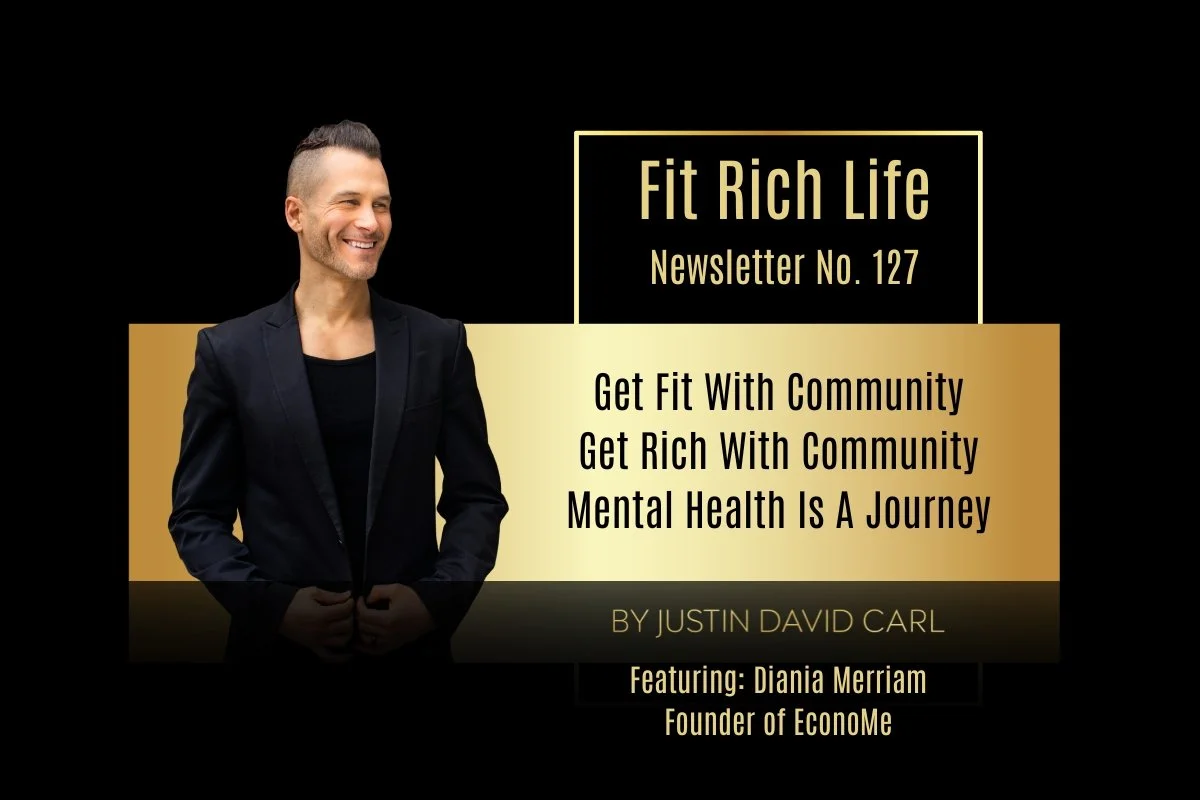
This past week on the Fit Rich Life Podcast (episode 108), I’m joined by Diania Merriam, founder of EconoMe, the largest financial independence gathering in the world.
I went to my first EconoMe earlier this year.
And I left with this reminder:
Money is not the whole game.
Money is one part of the game.
The real game is learning how to use your money, your body, your time, your energy, and your relationships to build a life that actually feels rich.
That is what Diania and I talked about in this episode.
Her journey started with a dream to walk the Camino de Santiago — a 500-mile trek across northern Spain.
At the time, she had debt.
She was living in New York City.
She was doing well in her career, but not fully aware of what was happening with her money.
And she assumed that if she wanted to take two months off to walk across Spain, she would have to quit her job.
So she started cleaning up her finances.
She got out of debt.
She discovered the FIRE movement.
She found Mr. Money Mustache’s article, The Shockingly Simple Math Behind Early Retirement, which was also a part of my own FI awakening.
And what started as a desire to take a meaningful adventure became the beginning of her financial independence journey.
That’s one of my favorite things about this conversation.
Diania did not discover financial independence because she wanted to stare at a spreadsheet forever.
She discovered financial independence because she wanted more life.
More adventure.
More freedom.
More possibility.
More aliveness.
That is what this whole thing is supposed to be about.
Not hoarding money.
Not depriving yourself.
Not proving how frugal you can be.
Not optimizing every ounce of joy out of your life.
It is about using money as a tool to create a more meaningful, more intentional, more alive life.
That is the Fit Rich Life.
Now let's dive into Diania's strategies for fitness, money, and life:
FIT — Get Fit With Community
One of Diania’s biggest fitness takeaways at the end of our conversation was the power of community.
She shared that she is currently doing a Better Body Challenge with a group of friends.
And she said something that immediately made sense to me:
Doing fitness in community has helped her become someone she did not even know she could become.
She is lifting weights.
She is running.
She is working out five days per week.
And she is enjoying it.
That is the magic.
Because the goal is not just to force yourself into exercise.
The goal is to become the kind of person who enjoys taking care of their body.
This is why I am such a big believer in finding your fitness community.
For me right now, that is pickleball.
I play five to seven times per week.
I average 12 to 20 hours of pickleball per week.
It is basically a part-time job that pays me in joy, movement, friendship, sunlight, competition, and flow.
In the last year, I have made at least 100 new friends through pickleball.
My 44th birthday party was a pickleball party.
People in their 20s, 30s, 40s, 50s, 60s, 70s, and even 80s showed up.
That is not just exercise.
That is health.
That is community.
That is happiness.
That is life energy.
Diania’s fitness tools from the episode:
1. Do fitness in community.
Find a challenge, group, class, sport, walking buddy, gym crew, pickleball group, running club, or anything that helps you become more consistent through connection.
2. Get assessed by a physical therapist.
Diania kept throwing her back out and assumed it was a weak core. After seeing a physical therapist, she learned it was actually weak glutes and compensation patterns.
That is such a powerful reminder.
Sometimes the thing you think is the problem is not the actual problem.
3. Do the recovery work your body actually needs.
Diania learned she is hypermobile, which means stretching more was not the answer for her. She needed manual therapy and muscle release work.
This is huge.
Fitness is not just training harder.
It is learning your body.
4. Use tools that meet you where you are.
Diania recommended the None to Run app for people who want to get into running but do not currently identify as runners.
Identity matters.
If you do not see yourself as a runner, lifter, athlete, or fit person yet, use tools that help you build that identity one small win at a time.
5. For women: consider training with your cycle.
Diania shared that she has learned to adjust her workouts around her menstrual cycle, backing off intensity when her body needs more recovery.
That is wisdom.
Fitness is not about forcing.
Fitness is about listening, adapting, and building a body that supports the life you want to live.
RICH — Get Rich With Community
One of my favorite things Diania said in this conversation was:
“I do not believe in delayed gratification.”
That might sound strange coming from someone who paid off debt, saved and invested aggressively, and reached financial independence.
But what she meant is powerful.
The goal is not to white-knuckle your way through life wanting things you are constantly denying yourself.
The goal is to change your relationship with desire.
It is not enough to not buy the Tesla.
You want to become someone who does not want the Tesla.
That is freedom.
Because when you do not want the thing, you do not have to negotiate with yourself about whether or not to buy the thing.
You just do not buy things you do not want.
This hit me hard because that was my experience too.
Before discovering financial independence, I drove a Range Rover.
I was living in Hollywood.
I worked in the nightclub industry.
I was surrounded by people trying to look rich.
And I was spending 120% of my income trying to keep up with a life that looked good on the outside and was financially broken on the inside.
Then I discovered FI.
I sold the Range Rover.
I bought a 2012 Toyota Prius.
I stopped eating out at restaurants unless someone else was paying.
I stopped spending hundreds of dollars per month on massages and learned how to use a foam roller, Theragun, massage balls, and self-care tools.
I did not experience that as deprivation.
I experienced it as liberation.
Because every dollar I did not spend trying to look rich became a dollar I could spend on my freedom.
My friend and mentor JL Collins says that when you pursue financial independence, you are not actually depriving yourself.
You are spending lavishly on your freedom by buying shares of investments.
I love that.
Because that is exactly how it felt.
I was not cutting back.
I was buying freedom.
And that is a very different experience.
Diania’s money strategy at the end of the episode was simple and profound:
Community is fuel on a contrarian path.
If you are pursuing financial independence, you are choosing a countercultural path.
Most people are not trying to save and invest 30%, 40%, 50%, or more of their income.
Most people are not asking, “How much is enough?”
Most people are not trying to buy back decades of their life.
Most people are not intentionally choosing old cars, smaller homes, simpler lifestyles, or index funds over lifestyle inflation.
So if you are doing this alone, you may start to think you are crazy.
You are not crazy.
You just need to find your people.
When I discovered FI, I created a local financial independence meetup for selfish reasons.
I needed people around me who normalized saving, investing, freedom, and intentional living.
Within a few months, 30 to 50 people were showing up every month.
That changed my life.
I also went to CampFI in 2018 during the first year of my FI Journey.
That changed my life too.
This year, I went to EconoMe.
And it reminded me again:
Environment shapes desire.
When I lived in Menlo Park, Teslas were everywhere.
I saw them constantly.
And I wanted one.
Then I moved to Santa Cruz, where there are fewer Teslas constantly programming my nervous system, and the desire faded.
That is not an accident.
We are influenced by our environment.
We are influenced by our friends.
We are influenced by what gets celebrated around us.
In some circles, people brag about new luxury cars.
In the FI community, people brag about driving a 200,000-mile car that still runs.
Choose your circles wisely.
Because your community will either fuel your freedom or fuel your consumption.
LIFE — Mental Health Is A Journey
One of the most powerful parts of this conversation was Diania’s honesty about what can happen after financial independence.
We often imagine that money will solve everything.
Once I have enough money, I will finally be happy.
Once I leave the job, I will finally be free.
Once I hit my FI number, I will finally feel safe.
But what happens when you get there and realize money was not the whole problem?
Diania talked openly about the existential crisis that can come with having enough.
When you no longer have the illusion that more money will solve your problems, you are left with yourself.
Your nervous system.
Your relationships.
Your unprocessed emotions.
Your old wounds.
Your habits.
Your identity.
Your relationship with time.
That can be disorienting.
I deeply relate to this.
I hit financial independence.
I left the 9-to-5.
And for the first year, a part of me was still trying to recreate the high income from my sales career.
Even though I did not need more money.
Even though I was already free.
Even though the entire point was to build a richer life.
My default setting was still:
Make more.
Achieve more.
Grow the net worth.
Prove yourself.
But over the last two years, my focus has shifted.
I am much less interested in maximizing my net worth.
I am much more interested in maximizing my Ultra High Net-Life.
That means:
More time with Carly.
More pickleball.
More walks.
More sleep.
More fitness.
More friendships.
More ocean.
More writing.
More meaningful conversations.
More freedom to follow my curiosity.
More presence.
More joy.
More life.
Diania said something in our conversation that I have been thinking about ever since:
At a certain point in your financial journey, the risk flips from running out of money to running out of time.
Read that again.
At a certain point, the bigger risk is not running out of money.
The bigger risk is running out of life while still behaving like money is the only thing that matters.
This is where the journey gets interesting.
Because the skills that help you reach FI are not always the same skills that help you enjoy FI.
On the way to FI, you need tracking, discipline, investing, earning, saving, and focus.
After FI, you need presence, identity, purpose, play, emotional processing, nervous system regulation, relationships, and the courage to stop optimizing everything for more money.
That is a different game.
Diania’s life/happiness strategy was deeply vulnerable:
Keep seeking.
She shared that mental health has been the biggest challenge of her life.
She has tried therapists, psychiatrists, doctors, different modalities, and spent a significant amount of money trying to find solutions.
And while she has not fully figured it out, she has kept seeking.
She is exploring nervous system regulation work.
She is exploring deeper biological and genetic explanations.
She is continuing to look for answers.
That message matters.
Because sometimes the answer is not “just go to therapy.”
Sometimes therapy helps.
Sometimes it does not.
Sometimes you need a different practitioner.
Sometimes you need a different modality.
Sometimes you need nervous system work.
Sometimes you need medical testing.
Sometimes you need movement, sunlight, community, sleep, nutrition, spirituality, medication, emotional processing, purpose, or all of the above.
Mental health is complex.
But Diania’s message was hopeful:
Keep seeking.
Your life is worth the effort.
ACTION — Build Your Community
Pick one thing to upgrade this week:
1. FIND YOUR FITNESS PEOPLE
Join a gym class. Go to a pickleball open play. Invite a friend on a walk. Sign up for a running group. Start a step challenge. Find one person who wants to move their body and become healthier with you.
Fitness becomes easier when it becomes social. Community helps you become someone you may not have been able to become on your own.
2. GET AROUND PEOPLE WHO BUILD WEALTH
Go to a local FI meetup. Join an online money community. Attend CampFI. Attend EconoMe. Start a monthly money conversation with friends who are also trying to save, invest, and build freedom.
If everyone around you is trying to look rich, it will be harder to build wealth. If everyone around you is choosing freedom, simplicity, and intentional living, it becomes easier to do the same.
Community is fuel on a contrarian path.
3. BUILD YOUR HIGH NET-LIFE CIRCLE
Spend more time with people who value health, freedom, presence, relationships, adventure, purpose, and joy.
Your environment shapes your desires. Your community shapes what feels normal. Your people either pull you toward the life you want or keep you stuck in the life you are trying to outgrow.
Choose the room wisely.
Then listen to the full conversation with Diania Merriam so you can:
Hear how walking the Camino de Santiago sparked her financial independence journey.
Learn how she paid off $30,000 of debt and started saving and investing a huge percentage of her income.
Understand why changing your desires can be more powerful than delayed gratification.
Hear why community is not just nice to have — it is fuel.
Learn why EconoMe has become one of the most powerful gatherings in the financial independence world.
Understand what can happen after FI, when money is no longer the main problem to solve.
Get inspired to build a life where health, wealth, time, relationships, and freedom all work together.
Listen here:
🎧 Spotify | 🍎 Apple | ▶️ YouTube | 🌐 Web
To your health, wealth, and happiness,
— Justin David Carl